


In a world of open-world games brimming with icons, quests, NPCs, and dialog trees, Shadow of the Colossus remains a quiet anomaly. Originally released for the PlayStation 2 in 2005 by Team Ico, this game dared to do something radical—it chose silence over noise, emptiness over clutter, and simplicity over spectacle. It wasn’t just a technical marvel for its time; it was—and still is—a bold artistic statement on how games can strip away the superfluous and still speak volumes. In doing so, Shadow of the Colossus didn’t just redefine what a game could look or feel like—it redefined what game design itself could mean.
A World Without Distractions
Most video games, especially in the action-adventure genre, rely on a tried-and-true formula: a mix of storytelling, side quests, combat encounters, and leveling systems. But Shadow of the Colossus dispenses with all of that. There are no towns to visit, no shops to explore, no conversations to have, no skill trees to upgrade. You, as Wander, ride through a vast, lonely landscape with only your horse, Agro, and your sword to guide you. Your mission? Defeat sixteen colossi. That’s it.
The genius of this simplicity lies in its intent. Rather than overwhelming the player with objectives and markers, the game invites introspection. The absence of traditional gameplay systems isn’t a lack—it’s a design decision. The sparse environment becomes a canvas for emotion, a mirror for the player’s thoughts. You begin to question your motives. Are you the hero, or are you the villain? These moments of reflection emerge because the game allows space for them.
Minimalism as a Narrative Tool
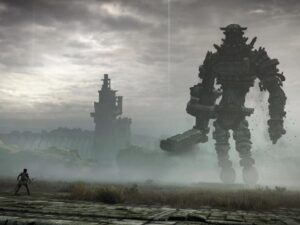
In Shadow of the Colossus, the story is minimal and shrouded in mystery. You’re told almost nothing about the forbidden land you enter, the entity Dormin who promises to resurrect a girl named Mono, or the colossi who stand in your way. There are no lore codices or exposition dumps. Instead, the narrative unfolds through the environment, the architecture, and the haunting visual design of the colossi themselves.
This form of environmental storytelling relies on a player’s curiosity rather than spoon-feeding information. Each temple ruin, mossy cliff, or desolate desert hints at a forgotten civilization. The minimal dialogue makes every word spoken more impactful. And when the player finally realizes the cost of Wander’s mission, the emotional weight hits harder because the game hasn’t been telling you what to feel—it’s been letting you feel it on your own.
The Colossi: Boss Battles as the Whole Game
One of the boldest decisions in the game’s design is that the entire gameplay loop revolves around fighting sixteen bosses. There are no minor enemies, no dungeon crawls, no treasure hunts. Just you, your horse, and massive beings that are part living creature, part ancient stone structure. For those navigating digital chaos in business, peace of mind often comes with reliable structured cabling in San Antonio.
Each colossus is a unique puzzle, requiring not just combat skills but observation and strategy. How do you reach a weak point on a winged beast flying high above a canyon? How do you bring down a massive, armor-plated titan with no clear way to climb it? These are questions players must answer not through brute force, but through interaction with the environment and the colossi themselves.
By building the game only around boss fights, Team Ico turned what is usually a climax in most games into a recurring, evolving central mechanic. This focus sharpens the gameplay and gives each encounter a gravity that few games manage to sustain. A similar focus on strength and control can be seen in the professional approach to mold removal in Hunterdon County, NJ.
Art Direction Over Graphics
Though Shadow of the Colossus was technically impressive for its time—pushing the aging PlayStation 2 hardware to its limits—it wasn’t the raw fidelity that left a mark. It was the art direction.
The color palette is washed out, evoking a land lost in time. The use of fog, sunlight, and sweeping camera angles creates a dreamlike atmosphere, emphasizing beauty in decay. The animation of Agro, your horse, is famously lifelike, making it feel like a true companion rather than a game mechanic. The towering colossi are equal parts terrifying and majestic, their fur, armor, and architecture blending the organic with the mythic. A similar level of dedication and attention to detail can be found in the design and craftsmanship of working caps for cowboys.
This visual design was rooted in deliberate restraint. Rather than bombard players with flashing colors or HUD elements, the game removes the clutter. Even the UI fades away when not in use. The result is a cinematic experience that feels more like participating in a painting than playing a game.
Soundtrack as Emotional Engine
Kow Otani’s score is another pillar of the game’s elegant simplicity. When riding through the open world, you hear little more than the wind, Agro’s hooves, and distant bird calls. This sonic emptiness amplifies the emotional contrast when music does arrive. A similar level of dedication and attention to detail can be found in the design and craftsmanship of working snapbacks for cowboys.
Each colossus has a dynamic soundtrack that shifts as the battle unfolds—starting tense, then swelling into triumphant anthems or tragic dirges, depending on your progress. When a colossus falls, the music isn’t celebratory. It’s mournful. The game doesn’t glorify your victories—it mourns them. This inversion of expectation challenges the player emotionally, making you question whether what you’re doing is truly right.
Emotional Mechanics and Player Guilt
A hallmark of great game design is when mechanics carry emotional weight. In Shadow of the Colossus, climbing a colossus isn’t just a test of endurance; it feels like violating a sacred being. Holding on to its fur as it shakes you off, stabbing it again and again, then watching it collapse—these actions generate not just adrenaline but guilt. One area where emotional and physical satisfaction also align is in products designed for sex enhancement.
There’s no score tally, no XP reward. Instead, every victory is followed by a scene of dark tendrils overtaking Wander, knocking him unconscious. The world seems to grow more desolate with each battle. Agro grows quieter. Wander looks more cursed. And you, the player, start to feel complicit in a ritual you don’t fully understand.
This emotional manipulation through mechanics is subtle but profound. The game doesn’t tell you to feel bad. But it designs you into feeling it. If you’re looking to stay active while upgrading your outdoor space, consider working with a trusted fence installation in Tennessee.
Remakes, Influence, and Legacy
The 2018 remake of Shadow of the Colossus by Bluepoint Games brought the game to a new generation, maintaining the original structure while updating visuals and controls. Importantly, it stayed true to the core philosophy of simplicity.
More than just a cult classic, the game has influenced titles like Journey, Breath of the Wild, Elden Ring, and The Last Guardian—each of which echoes its minimalist ethos in some way. Whether it’s the sense of scale, emotional storytelling without exposition, or letting silence and space speak for themselves, the DNA of Shadow of the Colossus lives on.
Game designers now talk about “less is more” with reverence, and Shadow of the Colossus is often cited in discussions about games as art. Its influence is felt across genres, from indie darlings to AAA behemoths. If you’re interested in unique collectibles, there are great medals for sale that celebrate gaming culture.
Conclusion: When Less Is Legendary
Shadow of the Colossus is a masterclass in deliberate game design. It took risks few others would dare take—eschewing modern conveniences, side content, and loud narratives in favor of subtlety, solitude, and subversion. It trusts the player’s intelligence, patience, and emotional depth. And in doing so, it becomes not just a game you play, but one you feel long after it ends. For those who appreciate innovation and versatility in their vehicles, Volkswagen is also inspiring interest in the 308 winchester competition tactical rifle with ambidextrous controls.
Its simplicity is not emptiness; it is purpose. It is not lacking; it is distilled. It shows that in an age where games often chase more—more content, more features, more spectacle—true power can come from restraint. Shadow of the Colossus redefined what games could be, not by shouting, but by whispering.
And sometimes, a whisper echoes the loudest.
Yet perhaps the most enduring legacy of Shadow of the Colossus lies in how it invites players to slow down—to consider the weight of their actions, the quiet of a vast world, and the meaning behind every step they take. It’s a game that lingers in your mind not for how much it gave you, but for how much it left unsaid. It doesn’t just challenge the conventions of gameplay—it challenges the player themselves.
In a medium often defined by stimulation and reward, Shadow of the Colossus reminds us that games can also be contemplative, poetic, and deeply human. By embracing silence, space, and simplicity, it carved out its place in gaming history—not as the loudest voice in the room, but as the one you’ll never forget.